THE RED SCARE
The immediate post-war period in the United States was dominated by the Cold War. Within a hundred days of the successful defeat of Nazi Germany in Europe, the Allies were divided. As explored in the Cold War unit, many historians believe that this division was inevitable as capitalism and communism were incompatible system. However, that did not prevent many Americans from being so concerned about what they saw as Soviet aggression in Eastern Europe following a string of Cold War events between 1945 and 1949: the Potsdam Conference, the Iron Curtain speech, the Greek Civil War, electoral success of communism in France and Italy, a coup d'etat in Czechoslovakia and the continued division of Germany.
This concern transformed to fear following the discovery of evidence that there were Soviet spies within the American government. As a result of the VENONA project, a Soviet cable-decrypting operation run by the US Army Signal Intelligence Service (a forerunner of the NSA or National Security Agency), a number of individuals were accused of handing over secrets, including information about nuclear weapons, to the USSR. These people included Alger Hiss, a high-ranking State Department official and Julius and Ethel Rosenberg, who were later executed for espionage in 1953. When China 'fell' to communism under Mao Zedong and the USSR gained their first nuclear bomb in 1949, the suspicion that there were members of the Truman administration and federal government working for the Soviet Union only hardened.
These events ushered in the era of McCarthyism (or Second Red Scare), which was characterized by communist witch-hunts, political mud slinging and intense paranoia that damaged American society and discredited the USA abroad. Although anti-communist attacks in this era are considered to be part of McCarthyism, Joseph McCarthy (after whom the term was coined) did not receive national attention until 1950. Between 1947 and 1950, the anti-communist investigation was carried out by HUAC (House Un-American Activities Committee).
This concern transformed to fear following the discovery of evidence that there were Soviet spies within the American government. As a result of the VENONA project, a Soviet cable-decrypting operation run by the US Army Signal Intelligence Service (a forerunner of the NSA or National Security Agency), a number of individuals were accused of handing over secrets, including information about nuclear weapons, to the USSR. These people included Alger Hiss, a high-ranking State Department official and Julius and Ethel Rosenberg, who were later executed for espionage in 1953. When China 'fell' to communism under Mao Zedong and the USSR gained their first nuclear bomb in 1949, the suspicion that there were members of the Truman administration and federal government working for the Soviet Union only hardened.
These events ushered in the era of McCarthyism (or Second Red Scare), which was characterized by communist witch-hunts, political mud slinging and intense paranoia that damaged American society and discredited the USA abroad. Although anti-communist attacks in this era are considered to be part of McCarthyism, Joseph McCarthy (after whom the term was coined) did not receive national attention until 1950. Between 1947 and 1950, the anti-communist investigation was carried out by HUAC (House Un-American Activities Committee).
|
|
Like many Western countries with a diverse population, there were elements of American society that possessed a fear of immigrants. This xenophobia had been prevalent during the Red Scare in the post-World War I period and responsible for the internment of Japanese Americans during World War II.
It should also be noted that the Democratic Party had held the Presidency and both Houses of Congress since the 1932 elections. The Republican Party were desperate to end this dominance and the McCarthy era presented an opportunity to attack progressive Democrats (especially supporters of FDR's New Deal) as 'socialist', 'communist' or 'left-wing'. At this time, being vehemently anti-Communist was a great career move- one of the leading members of HUAC (House Un-American Activities Committee) who pushed for an investigation of Alger Hiss was none other than future President Richard Nixon, who used the publicity from the Hiss case to further his political career. |
The era of HUAC (1947-1950)
|
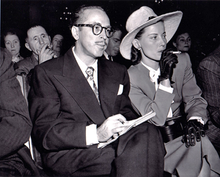
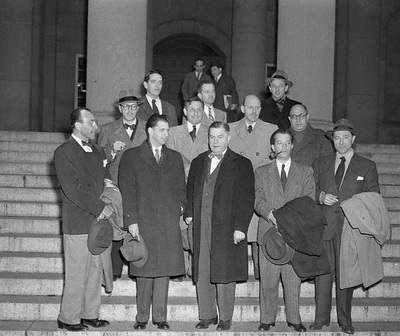
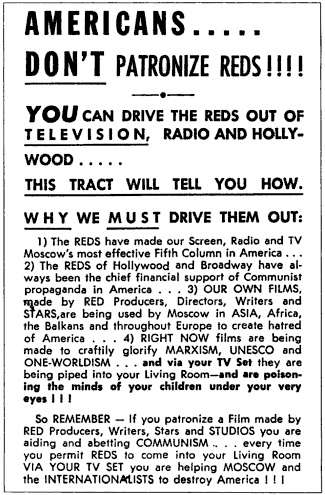
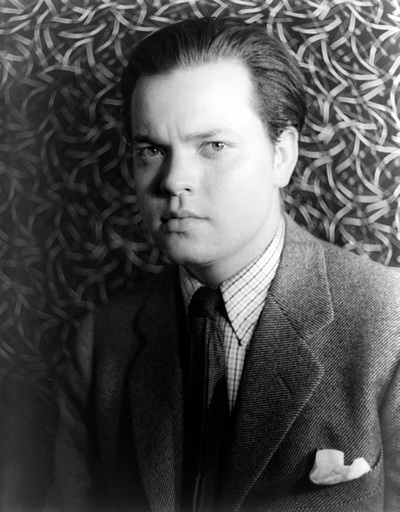
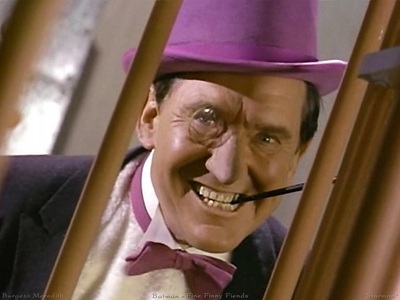
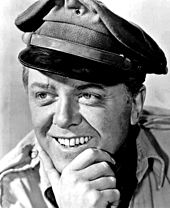
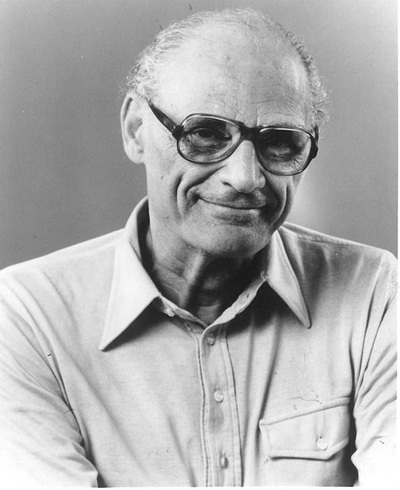
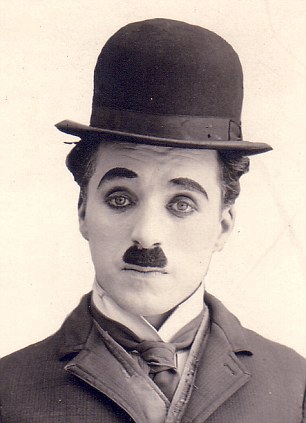
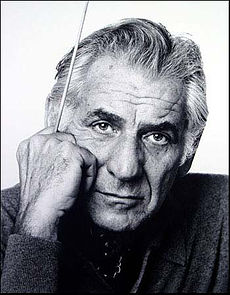
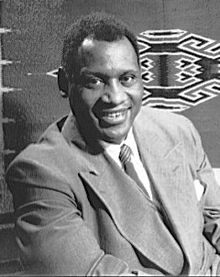
HUAC began investigating Hollywood- a reliably liberal community- and called on many actors, screenwriters, directors and producers from the American film industry to testify before congress. Famous individuals subpoenaed included Ronald Reagan, Walt Disney and Gary Cooper. Some suspected communists were asked the question: "Are you now or have you ever been a member of the Communist Party?" Failure to answer this question or a request to plead protection under the 5th Amendment (which allows individuals to not self-incriminate under oath) was seen as implying guilt. The so-called 'Hollywood Ten' were found in criminal contempt of Congress for refusing to answer questions before HUAC and they, as well as many other members of Hollywood, were blacklisted, meaning they were barred from employment in the entertainment industry. See the gallery (to the right) for pictures of blacklisted individuals.
Hot on heels of the Hollywood hearings was the investigation into Alger Hiss. Although VENONA had uncovered evidence of espionage regarding Hiss (the project had already exposed German-British spy Klaus Fuchs and the Cambridge Spy Ring), it was not until former Communist Party member turned informant Whittaker Chambers accused Hiss of being a Soviet spy that HUAC investigations began. Following a failed attempt to prosecute Hiss for espionage, he was sentenced instead to 15 years in prison for perjury.
In 1947, Truman launched the Federal Loyalty Program. This was designed to investigate the presence of communists or communist sympathizers in the executive branch of the federal government. "Loyalty Boards" were established to ensure that all federal employees, as well as prospective employees, were "...of complete and unswerving loyalty to the United States". The Truman administration also argued that communists or communist sympathizers within the federal government could also act to harm, disrupt or destroy the democratic processes so valued by many Americans. Historians have also argued that the main purpose of the Federal Loyalty Program was to stave off political attacks from the Republican Party, particularly on foreign affairs. The effects of the Federal Loyalty Program were mass firings and mass resignations- 200 employees were fired and 2000 more resigned between 1947 and 1951. It also allowed the FBI, under director J. Edgar Hoover, to undertake separate investigations into individuals suspected of subversive activities. Hoover's investigations would prove to be particularly intrusive and damaging to those people targeted. Joseph McCarthy (1950-1954)
The worst excesses of communist paranoia within US society only began when Senator Joseph McCarthy achieved political prominence. McCarthy was a career-focused demagogue from Wisconsin and on New Year's Day 1950 delivered his infamous "Wheeling speech" (so named because the speech was delivered in Wheeling, West Virginia), where he claimed to have a list of 57 Soviet spies working in the US State Department. His claims of Soviet espionage and sabotage were notoriously inconsistent; over the years the number of people he claimed to be Soviet spies working within the US government variety dramatically.
|
|
|
|
McCarthy's attacks followed the Soviet Union's development of an atomic bomb and the "fall" of China to Mao's Communist Part in 1949 and were bolstered by the North Korean invasion of South Korea in June 1950. Such was McCarthy's power (his accusations led to furious and alarming levels of witch-hunt within the federal government and American society) that many Democrats failed to confront him, no matter how absurd his claims were, for fear of being accused of being accused as a communist. This included President Truman, who was reticent to attack McCarthy, even when ex-Secretary of State (and WWII general) George Marshall was accused of subversion after the communist victory in the Chinese Civil War. For his part, McCarthy used his attacks to ruthlessly increase his power and influence within American society.
One of the sole critics of McCarthy was CBC news anchor Edward R. Murrow. He, along with a few other journalists, committed to hold McCarthy accountable for his vague and outlandish claims that were not supported by solid evidence. An example of one of these claims was the accusation of communist subversion levelled at John Hopkins professor Owen Lattimore (who taught Asian Studies). Lattimore was one of the few 'subversives' mentioned by name and his only connection to communism appeared to be a failure to criticise Stalin or Mao. Lattimore was the last person McCarthy mentioned by name but he did manage to successful smear the 1952 Democratic Presidential Nominee, Adlai Stevenson. McCarthy's downfall finally arrived in 1954 when he took on the U.S. Army. The Congressional Army-McCarthy hearings were televised and exposed McCarthy as rude, evasive, arrogant and abusive. Finally, U.S. senators felt empowered to criticise and admonish McCarthy. Soon after the hearings, the Senate voted to censure him for his conduct during his many investigations. McCarthy's public image was irreparably damaged and he died 3 years later. While the witch-hunts dwindled after his censure, the fear of communism remained in American society for decades to come. |