CAUSES OF THE WAR IN VIETNAM
Like the Korean War, the war in Vietnam had its roots in decolonization. A former French colony, nationalistic and ideological fervor combined in Vietnam to create a void in Southeast Asia, of which both superpowers attempted to control. Many in the south saw the conflict as a civil war, with outside intervention, whereas many in the north saw the conflict as a second war of independence.
Liberation of French Indochina following WWII
|
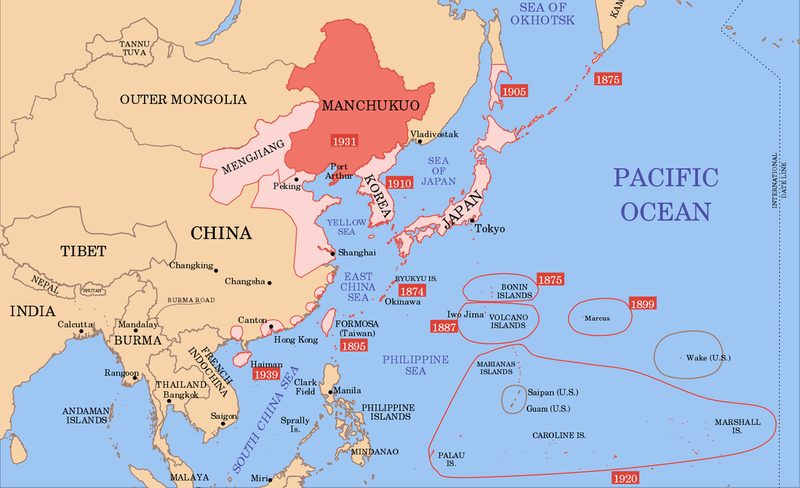
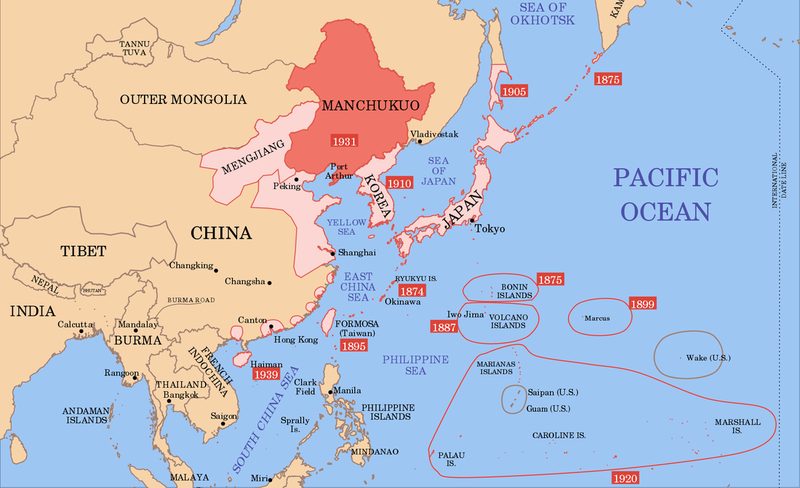
The Japanese seized control of Indochina (comprising Laos, Cambodia and Vietnam) in 1940 following the defeat of France in World War II. In 1941, a Vietnamese resistance movement, the Vietminh (under the leadership of Ho Chi Minh) was formed. They opposed both Japanese and French occupations but were also affiliated with the Communist party in the USSR. These ideological aspects were overlooked during World War II as the Allies sought to defeat the Japanese in Asia.
Following the Japanese surrender in August 1945, there was a brief period of handover to the French (which was overseen by the British and Chinese Nationalist troops) during which the Vietminh announced their opposition to renewed French control. On the 2nd of September 1945, Ho Chi Minh declared Vietnamese independence. He deliberately paraphrased the US declaration of independence in the hope of winning their support for the Vietminh's struggle. France-Indochina War
Although initially disapproving of the creation and maintenance of empire (colonial possessions formed part of trading networks that prevented a truly open and free global market), the US soon threw their support behind the French once it was clear that Ho Chi Minh was also a communist and that the superpowers were engaged in a Cold War.
|
|
For their part, the French struggled to maintain their control of a far-flung Asian colony in unfamiliar jungle and mountainous conditions at a time when they were painstakingly rebuilding their economy following WWII. The war was becoming increasingly unpopular with the French public as there seemed to be no end in sight and they considered the war to be fought at an unacceptable cost (both in terms of lives and money spent).
Dien Bien Phu and the Geneva Peace Accords
|
'France had already entered into 5 power negotiations with the UK, France, USSR and PRC at Geneva to decide the future of Indochina when they were handed a stunning and catastrophic defeat at Dien Bien Phu in May 1954. This defeat (masterminded by General Vo Nguyen Giap) sapped what any remaining French will to continue fighting and they signed a cease-fire with Vietminh immediately.
The Geneva Peace Accords that were subsequently signed agreed that Vietnam would be divided into two: a communist North Vietnam above the 17th Parallel and a capitalist South Vietnam below. North Vietnam would be under the control of Ho Chi Minh in their capital of Hanoi and South Vietnam under the leadership of Ngo Dinh Diem in Saigon. It was also agreed that elections on the future of the country would be held in 1956. These elections were cancelled by the Eisenhower administration over fears that the elections would neither be free and, more pertinently, that they would be won comfortably by Ho Chi Minh. The USA began to invest accordingly in Diem's South Vietnamese regime. Interestingly, the term 'Domino Theory' (the concept of which had already been articulated in reference to Korea) was used for the first time at Geneva by Eisenhower. |
NLF (Vietcong) Insurgency
|
It was not long after these elections were cancelled that the National Liberation Front (NLF) or Vietcong began their insurgency against the South Vietnamese government. The NLF were North Vietnamese-backed communist guerrilla fighters who planned acts of sabotage and terrorism in South Vietnamese cities (especially Saigon) and began to slowly take control of some South Vietnamese villages, especially close to the 17th Parallel.
Eisenhower had decided against American troops replacing the French immediately in opposition to the Vietminh in 1954 and watch events in Southeast Asia closely but cautiously throughout the rest of his presidency. While he believed that an American intervention in Southeast Asia was increasingly likely, it was not quite clear where this intervention would happen and in what form it would take. Throughout this period, a similar insurgency was being fought by the communist Pathet Lao against the American-backed monarchy in Laos. |
|
Once an agreement to end the Laotian Civil War was signed in Vienna in 1961, the Kennedy troops sent 16,000 'military advisers' to South Vietnam, officially to train and advice South Vietnamese Army (ARVN) forces. The NLF insurgency continued throughout the Kennedy presidency, who became particularly concerned by an ARVN defeat at the Battle of Ap Bac in January 1963. What was particularly alarming was that Ap Bac was very close to Saigon, that ARVN units significantly outnumbered NLF troops, possessed better weapons and were advised and supported by US military personnel (5 US helicopters were shot down at Ap Bac). Despite reassurances from Vice-President Johnson that Diem was the "Winston Churchill of Southeast Asia", Kennedy's faith in the South Vietnamese government was profoundly shaken and a creeping suspicion that US troops may have to defend South Vietnam from communist aggression began to emerge.
Buddhist unrest in South Vietnam
|
Concerns over the viability of the Diem regime increased substantially by the summer as his government launched a crackdown on the country's Buddhist population, who represented a majority in South Vietnam. Diem, along with his wife (known as Madame Nhu) and her brother, were Roman Catholics who originated from the South Vietnamese ruling elites who had been heavily favored by the French. When they began a harsh repression of the Buddhist, past tensions within South Vietnamese society re-emerged. Civil unrest was particularly acute in Saigon, where a Buddhist monk self-immolated as an act of protest.
TV news reports of the unrest made it clear to many around the globe that the Diem regime was not just authoritarian, but despotic too. While publicly continuing to state their support for South Vietnam, private back channels were opened between the CIA and South Vietnamese military. When a group of generals asked if American support for South Vietnam would remain if there was a change of government, the fairly innocuous and standard response of 'although there will be no American involvement in any regime change, any new government will be examined on its own merits'. |
Convinced that American support would remain in place, the generals launched a coup d'etat against Diem. Diem was assassinated on the 1st of November 1963 and so began a period of inconsistency in South Vietnam as the military dictatorships replaced one another with disturbing regularity. Even more significantly for the US, it was now clear that they were now responsible for the future of South Vietnam as it appeared that whoever was in charge would take their cue from Washington.
Gulf of Tonkin Incident
|
Three weeks after the removal and assassination of Diem, Kennedy was assassinated. Lyndon Johnson inherited the presidency and a rapidly deteriorating situation in South Vietnam. Despite privately expressing misgivings, Johnson publicly looked to escalate the war in Vietnam. He was given the
casus belli
he needed following reports of two attacks in the U.S.S Maddox in the Gulf of Tonkin in August 1964. The first attack occurred when the Maddox strayed into North Vietnamese waters while supporting a reconnaissance mission. The second attack was probably misreported and never took place.
However, Johnson used the incident to persuade Congress to pass the Tonkin Gulf Resolution, which allowed him to escalate the 'conflict' in Vietnam. |
|
Summary
US strategy leading up to obtaining authority from Congress to escalate the war in Vietnam was characterized by a combination of non-decision and 'drift'. Although American involvement was overwhelmingly driven by the doctrine of containment, there appeared to be little strategic consideration given to the implications of escalation and full involvement in Vietnam. Specifically, the type of war that would be fought and an appropriate exit strategy. Consequently, the US became embroiled in the longest war in its history and faced the same issues the French did between 1946 and 1954.