CAUSES OF WORLD WAR II
The World in the 1930's

United Kingdom
- Like all European countries, the UK was attempting to recover from the Great Depression after US aid and imperial trade had helped it to recover from WWI. The UK was one of the founding members of the League of Nations and had really used the organization to maintain its empire, although it did value the league as a useful international "talk shop". Maintaining the British Empire (India had a thriving independence movement in the 1930's) and avoiding another European war against either the Soviets or the Nazis (which was a major reason behind appeasement) were their main foreign policy goals.
France- As the UK, although did not see the League of Nations as a "talk shop". Desperately fearful of Germany and memories of WWI and Alsace Lorraine were still strong. They had built a huge defensive line in case of war with Germany known as the Maginot Line. However, like the UK, avoidance of war with Germany was a main foreign policy goal.
USA - was isolationist and focused on its own economic problems as well as preventing outside influences to interfere in the Americas. President Roosevelt was increasingly concerned about the growth of Fascism in Europe and aggression from Japan, but had to convince a reluctant US public to go to war.
USSR - was recovering from Stalin's Red Army purges of the 1930's. Large swaths of the Soviet officer class had been killed and Stalin desperately needed time to rebuild the Red Army. Memories of WWI and tensions with Germany still remained and he became very suspicious of British and French motives with regard to the policy of appeasement.
Germany- had been hit hard by the Great Depression. This event brought great instability to German politics and helped Hitler's Nazi Party rise to power. Once in power, Hitler pursued a number of aggressive foreign policy initiative designed to expand German power and territory and reverse the Treaty of Versailles.
Italy - had been controlled by a Fascist leader since 1922. Benito Mussolini's blackshirts also pursued an aggressive foreign policy as evidenced by their invasion of Abyssinia in 1936. After that event, Mussolini withdrew Italy from the League of Nations and signed the Rome-Berlin axis with Germany.
Japan- was nominally controlled by Emperor Hirohito who delegated foreign policy matters to the Japanese military, who also pursued an aggressive foreign policy. At the heart of this policy was the need to gain raw materials to fuel the Japanese industrial machine. This resulted in the invasion of Manchuria in 1931 and the Sino-Japanese War of 1937.
France- As the UK, although did not see the League of Nations as a "talk shop". Desperately fearful of Germany and memories of WWI and Alsace Lorraine were still strong. They had built a huge defensive line in case of war with Germany known as the Maginot Line. However, like the UK, avoidance of war with Germany was a main foreign policy goal.
USA - was isolationist and focused on its own economic problems as well as preventing outside influences to interfere in the Americas. President Roosevelt was increasingly concerned about the growth of Fascism in Europe and aggression from Japan, but had to convince a reluctant US public to go to war.
USSR - was recovering from Stalin's Red Army purges of the 1930's. Large swaths of the Soviet officer class had been killed and Stalin desperately needed time to rebuild the Red Army. Memories of WWI and tensions with Germany still remained and he became very suspicious of British and French motives with regard to the policy of appeasement.
Germany- had been hit hard by the Great Depression. This event brought great instability to German politics and helped Hitler's Nazi Party rise to power. Once in power, Hitler pursued a number of aggressive foreign policy initiative designed to expand German power and territory and reverse the Treaty of Versailles.
Italy - had been controlled by a Fascist leader since 1922. Benito Mussolini's blackshirts also pursued an aggressive foreign policy as evidenced by their invasion of Abyssinia in 1936. After that event, Mussolini withdrew Italy from the League of Nations and signed the Rome-Berlin axis with Germany.
Japan- was nominally controlled by Emperor Hirohito who delegated foreign policy matters to the Japanese military, who also pursued an aggressive foreign policy. At the heart of this policy was the need to gain raw materials to fuel the Japanese industrial machine. This resulted in the invasion of Manchuria in 1931 and the Sino-Japanese War of 1937.
Long-term Causes of the war in Europe
The Great Depression
This was in part caused by the Wall Street Crash in 1929, although this event contributed to underlying weaknesses in many economies. The Great Depression led to massive economic instability, high unemployment and significant social problems. This in turn created political instability in many countries, with some turning to extremist parties to resolve these issues. Outside of Germany, much of Eastern Europe had dictators in charge by 1938. Western democracies, such as Britain and France became more concerned with their own economic problems rather than with solving global disputes and supporting the League of Nations the way it was intended.
Nazi Foreign Policy
It would be dangerous to ignore the role that Adolf Hitler and the Nazis played in creating WWII , even if their policies were in part a response to the Great Depression and that they were enabled by the British and French policy of appeasement. Hitler's foreign policy aims included uniting the German Volk (German speaking peoples), reversing the Treaty of Versailles, creating Lebensraum (living space) in Eastern Europe and destroying Communism. Throughout the 1930's, he began the process of achieving these aims.
Click on this link to view an interactive timeline of these events:
Hitler's Foreign Policy Timeline
The Great Depression
This was in part caused by the Wall Street Crash in 1929, although this event contributed to underlying weaknesses in many economies. The Great Depression led to massive economic instability, high unemployment and significant social problems. This in turn created political instability in many countries, with some turning to extremist parties to resolve these issues. Outside of Germany, much of Eastern Europe had dictators in charge by 1938. Western democracies, such as Britain and France became more concerned with their own economic problems rather than with solving global disputes and supporting the League of Nations the way it was intended.
Nazi Foreign Policy
It would be dangerous to ignore the role that Adolf Hitler and the Nazis played in creating WWII , even if their policies were in part a response to the Great Depression and that they were enabled by the British and French policy of appeasement. Hitler's foreign policy aims included uniting the German Volk (German speaking peoples), reversing the Treaty of Versailles, creating Lebensraum (living space) in Eastern Europe and destroying Communism. Throughout the 1930's, he began the process of achieving these aims.
- In 1934, he withdrew from the International Disarmament Conference and the League of Nations. He also began rearming the German military
- In 1936, he remilitarized the Rhineland, which had been forbidden by the Treaty of Versailles
- In 1937, he sent the Condor Legion (part of the German air force or Luftwaffe ) to Spain to support General Franco's Nationalists in the civil war against the Republicans
- In 1938, he engineered an Anschluss (union) with Austria, despite this being banned by the Treaty of Versailles
- Also in 1938, he seized the Sudetenland, a rich industrial region of Czechoslovakia where many ethnic Germans lived
- He conquered Bohemia and Moravia, two other regions of Czechoslovakia, in 1939
Click on this link to view an interactive timeline of these events:
Hitler's Foreign Policy Timeline

| ww2_timeline_and_plotting.doc |
German aggression in Europe eventually brought them into conflict with Britain and France and there is significant evidence to suggest that Hitler was always determined to go to war.
Appeasement
Appeasement
Britain and France were desperate to avoid a repeat of WWI and this became more of a priority following the onset of the Great Depression. They also were not sure what to make of Hitler and whether Stalin's Soviet Union represented a greater threat to their interests. Throughout much of the 1930's, Britain and France sought to appease Germany in the hope that they could avoid war. Implicit in this was the acknowledgement that Germany had been harshly treated at the Treaty of Versailles in 1919. Therefore when Hitler broke the terms of the Treaty of Versailles by rearming and remilitarizing the Rhineland, there was no response from the UK and France. In response to the remilitarization of the Rhineland, one British politician said "they are merely going into their own back yard".
It is also fair to say that the UK and France were more preoccupied with Italy's invasion of Abyssinia at this time. There was again no response when the Germans and Austrians united in 1938 but appeasement reached its peak during the Sudetenland crisis and Munich Conference. The British and French responded to Hitler's claims to this region of Czechoslovakia by permitting them to seize it in return for a promise that they seek no more territory. The Czechs were not even in the room while this agreement was being negotiated. UK Prime Minister Neville Chamberlain returned to Britain proclaiming that he had "secured peace in our time."
This relief and momentary euphoria at avoiding a major European war subsided in April 1939 when the Germans invaded Bohemia and Moravia. The rest of Czechoslovakia was invaded by neighboring countries such as Poland, Hungary and Romania but the loss of the Sudetenland was the key to the destabilization of Eastern Europe's only remaining democracy at the time. Following this further act of German aggression, Britain and France issued a guarantee of Polish independence.
Although the British and French policy of experimenting with appeasement was over, there were still more consequences to face. In July 1939, Hitler signed the Nazi-Soviet Pact with the USSR. This was a mutually beneficial agreement that allowed Hitler the breathing room to invade Poland without risking war with Stalin's Soviet Union and also gave the USSR the time to rebuild the Red Army following the purges of the early 1930's. Stalin was also concerned that he could no longer trust Britain and France to stand up to Hitler, even suspecting them of trying to engineer a war between Nazi Germany and the USSR, thereby weakening or destroying both countries.
In the circumstances, Stalin felt a deal with Hitler was the best option, even though both leaders knew this non-aggression pact was a temporary measure. Part of this agreement was kept secret and that was that both sides agreed to divide Poland between them. The Eastern half of Poland would provide a useful "buffer" from German aggression for Stalin.
It is also fair to say that the UK and France were more preoccupied with Italy's invasion of Abyssinia at this time. There was again no response when the Germans and Austrians united in 1938 but appeasement reached its peak during the Sudetenland crisis and Munich Conference. The British and French responded to Hitler's claims to this region of Czechoslovakia by permitting them to seize it in return for a promise that they seek no more territory. The Czechs were not even in the room while this agreement was being negotiated. UK Prime Minister Neville Chamberlain returned to Britain proclaiming that he had "secured peace in our time."
This relief and momentary euphoria at avoiding a major European war subsided in April 1939 when the Germans invaded Bohemia and Moravia. The rest of Czechoslovakia was invaded by neighboring countries such as Poland, Hungary and Romania but the loss of the Sudetenland was the key to the destabilization of Eastern Europe's only remaining democracy at the time. Following this further act of German aggression, Britain and France issued a guarantee of Polish independence.
Although the British and French policy of experimenting with appeasement was over, there were still more consequences to face. In July 1939, Hitler signed the Nazi-Soviet Pact with the USSR. This was a mutually beneficial agreement that allowed Hitler the breathing room to invade Poland without risking war with Stalin's Soviet Union and also gave the USSR the time to rebuild the Red Army following the purges of the early 1930's. Stalin was also concerned that he could no longer trust Britain and France to stand up to Hitler, even suspecting them of trying to engineer a war between Nazi Germany and the USSR, thereby weakening or destroying both countries.
In the circumstances, Stalin felt a deal with Hitler was the best option, even though both leaders knew this non-aggression pact was a temporary measure. Part of this agreement was kept secret and that was that both sides agreed to divide Poland between them. The Eastern half of Poland would provide a useful "buffer" from German aggression for Stalin.
Short Term Cause
of the war in Europe
Encouraged by the failure of Britain and France to confront him and with the successful neutralization of the USSR, Hitler ordered an invasion of Poland. Believing that there would again be no meaningful response, German forces invaded Poland on 1st August 1939. Britain and France declared war two days later.
Encouraged by the failure of Britain and France to confront him and with the successful neutralization of the USSR, Hitler ordered an invasion of Poland. Believing that there would again be no meaningful response, German forces invaded Poland on 1st August 1939. Britain and France declared war two days later.
|
|
||||
The long-term causes of the war in the Pacific
Japanese Expansionism
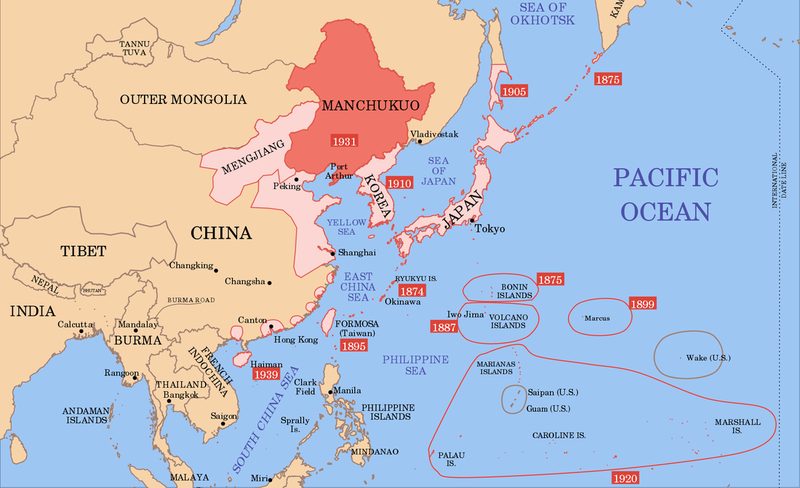
Following the Meiji Restoration of 1868, Japan embarked a program of rapid modernization that involved massive industrialization and emerged as a world power by 1900. As the Japanese home islands were not rich in the raw materials required for technological and industrial growth, Japan copied the European powers by acquiring overseas territories and colonies. During the second half of the 19th century, there were major structure changes to Japanese politics and society, one of these being the leading role the Japanese military played. As in Germany prior to 1914, a culture of militarism existed within Japanese society and was combined with notions of racial superiority similar to those held by the Nazis. Japanese expansion prior to World War Two included:
This article from Japan Today brilliantly explains how Japan created a expansionist mentality after WWI:
World War I: Japan's ill-fated 'gift from the heavens'
Japanese Expansionism
Following the Meiji Restoration of 1868, Japan embarked a program of rapid modernization that involved massive industrialization and emerged as a world power by 1900. As the Japanese home islands were not rich in the raw materials required for technological and industrial growth, Japan copied the European powers by acquiring overseas territories and colonies. During the second half of the 19th century, there were major structure changes to Japanese politics and society, one of these being the leading role the Japanese military played. As in Germany prior to 1914, a culture of militarism existed within Japanese society and was combined with notions of racial superiority similar to those held by the Nazis. Japanese expansion prior to World War Two included:
- The annexation of Formosa (now Taiwan) in 1895
- The defeat of Russia in the 1905 Russo-Japanese War and seizure of the South Manchurian Railway
- The annexation of Korea in 1910
- The award of German colonies (including islands in the South Pacific) as part of the Treaty of Versailles
-
The Manchurian Crisis (as covered at IGCSE- see the relevant pages in the IGCSE tab for a quick recap)
This article from Japan Today brilliantly explains how Japan created a expansionist mentality after WWI:
World War I: Japan's ill-fated 'gift from the heavens'
The Sino-Japanese War (1937-45)
In 1937, Japan used Manchukuo as a base to attack eastern and southern China to secure more resources and raw materials. Shanghai and the Chinese capital at the time, Nanjing, were seized very quickly. In Nanjing, terrible war crimes occured with estimates of the total dead ranging between 40,000 and 300,000. The Rape of Nanjing gained international notoriety but no significant response- the League of Nations had been effectively finished as an international collective security organization since the Abyssinian Crisis of 1936, the UK and France were preoccupied with events in Europe and were engaged in a policy of appeasement and the USA were firmly isolationist.
Short-Term Cause of the War in Pacific
US-Japanese tensions
Following the Japanese invasion of China, US-Japanese relations continued to deteriorate. President Roosevelt, a staunch opponent of fascism, warned the American public in his famous 'quarantine' speech that the US could not afford to remain isolationist if the aggressive foreign policies of Nazi Germany, Mussolini's Italy and Imperial Japan were allowed to dominate. After the start of World War II and the defeat of France by Germany in 1940, Japan capitalized by seizing the French colony of Indochina (modern Vietnam, Cambodia and Laos).
Knowing that the USA was the only rival to Japanese dominance in the Pacific and limited by the Neutrality acts, Roosevelt imposed an oil embargo on the Japanese (the USA was at that time the world's biggest exporter of oil). This move convinced the Japanese to begin planning the pre-emptive attacks on the US Pacific Fleet at Pearl Harbor, despite the facts they were still involved in negotiations with the Americans over the oil sanctions right up until the attacks took place. It later emerged that the negotiations over the trade dispute were merely a ruse to keep the US off-guard. On the day of and the day after the Pearl Harbor attacks, the Japanese seized huge chunks of territory in Southeast Asia, including the resource rich Philippines and Dutch East Indies (modern Indonesia).
In 1937, Japan used Manchukuo as a base to attack eastern and southern China to secure more resources and raw materials. Shanghai and the Chinese capital at the time, Nanjing, were seized very quickly. In Nanjing, terrible war crimes occured with estimates of the total dead ranging between 40,000 and 300,000. The Rape of Nanjing gained international notoriety but no significant response- the League of Nations had been effectively finished as an international collective security organization since the Abyssinian Crisis of 1936, the UK and France were preoccupied with events in Europe and were engaged in a policy of appeasement and the USA were firmly isolationist.
Short-Term Cause of the War in Pacific
US-Japanese tensions
Following the Japanese invasion of China, US-Japanese relations continued to deteriorate. President Roosevelt, a staunch opponent of fascism, warned the American public in his famous 'quarantine' speech that the US could not afford to remain isolationist if the aggressive foreign policies of Nazi Germany, Mussolini's Italy and Imperial Japan were allowed to dominate. After the start of World War II and the defeat of France by Germany in 1940, Japan capitalized by seizing the French colony of Indochina (modern Vietnam, Cambodia and Laos).
Knowing that the USA was the only rival to Japanese dominance in the Pacific and limited by the Neutrality acts, Roosevelt imposed an oil embargo on the Japanese (the USA was at that time the world's biggest exporter of oil). This move convinced the Japanese to begin planning the pre-emptive attacks on the US Pacific Fleet at Pearl Harbor, despite the facts they were still involved in negotiations with the Americans over the oil sanctions right up until the attacks took place. It later emerged that the negotiations over the trade dispute were merely a ruse to keep the US off-guard. On the day of and the day after the Pearl Harbor attacks, the Japanese seized huge chunks of territory in Southeast Asia, including the resource rich Philippines and Dutch East Indies (modern Indonesia).