THE KOREAN WAR
|
The Korean war was the first major conflict in the Cold War but which set the tone for many of the Cold War conflicts that were to follow. The Korean War was essentially a civil war with foreign intervention. Korea had been controlled by the Japanese since 1910 but had been liberated by the Soviets and Americans at the end of World War II in 1945. Since the end of the war, Korea was divided into North and South at the 38th Parallel. North Korea (Democratic Peoples' Republic of Korea or DPRK) was a communist state set up by the Soviet Union and ruled by Kim Il-Sung. South Korea (Republic of Korea or ROK) was a non-communist state supported by the United States and ruled by Rhee Syngman.
Both North and South Korea wanted to unite the Korean peninsula under one government but obviously disagreed as to what this government should look like. Kim Il-Sung and Stalin
Kim was indebted to Stalin, as the Soviet Union liberated North Korea and established him as leader in 1945. As a result, he felt it necessary to ask permission for an invasion of the South, especially as he might require their support. He first asked for permission in March 1949 but was denied. Stalin was particularly concerned that Kim might drag the USSR into a land war in Asia and a confrontation with the United States, especially as his focus was still on Europe and Berlin in particular (the Berlin Blockade and Airlift was still ongoing at this point).
However, four events occurred between June 1949 and January 1950 that combined to change Stalin's mind. First of all, American troops withdrew from South Korea. Secondly, the USSR successfully tested an atomic bomb and became the world's second nuclear power. Thirdly, Mao's Chinese Communist Party (CCP) won the Chinese Civil War and established the People's Republic of China (PRC). Finally, the US Secretary of State Dean Acheson announced the Outer Pacific Defense Perimeter as including only Japan, Taiwan and the Philippines. The final two events are particularly important. A potentially very powerful communist emerged in Asia who could support North Korea and carry the burden of spreading communism in the region, allowing the Soviet Union to focus on Europe. The failure of Acheson to mention South Korea made Stalin think that the USA were not interested in keeping the country in its sphere of influence. Rhee Syngman and the Truman Administration
US failure to mention South Korea was not without some good reason. Rhee's leadership, especially his self-styled image as authoritarian strongman, was beginning to concern the State Department. Although supported mostly because of his anti-communist credentials, his erratic decision making and apparent willingness to act without consultation with the USA alarmed Washington D.C.
Following the withdrawal of US troops from South Korea, the USA were reluctant to send military aid for fear that Rhee would order an invasion of the North, therefore dragging the US into a costly land war in Asia potentially involving the Soviet Union. The start of the 6.25 War |

|
|
In April 1950, Stalin finally gave Kim permission to launch an invasion of South Korea, on the condition that the PRC assist North Korea if necessary. Crucially for later Sino-Soviet relations, Mao was not present at this meeting and was only informed of this decision the following month. On the 25th of June 1950, North Korean tanks and troops crossed the 38th Parallel (hence why the war is referred to as the 6.25 War in South Korea).
The Truman Administration decided to respond immediately and chose to use the newly-formed United Nations to launch a 'Police Action' in Korea (a term used by Truman to bypass the requirement to seek congressional approval to commit American troops to war). On the 27th of June, a UN Security Resolution was successfully passed with authorized military intervention. This resolution was largely able to pass because of the continued absence of the PRC and the USSR from the Security Council- the USA had prevented the PRC from taking China's permanent seat on the Security Council (it was awarded to Taiwan instead) and the USSR boycotted the UN in support of the PRC. By September 1950, North Korean forces occupied the entire peninsula, with the exception of a small south-eastern corner of South Korea around the city of Busan. UN troops, under the command of US General Douglas MacArthur, landed at Inchon (near Seoul on the opposite side of the peninsula) to begin the operation to liberate the South from Northern control. |

|
The winter of 1950/1
|
The amphibious landing at Inchon was a success. By the end of September, UN forces had succeeded in retaking Seoul and pushing DPRK forces north of the 38th Parallel. At this point, MacArthur asked Truman permission to invade North Korea. This request was crucial in determining the course of the rest of the war. It was also significant because it indicated that MacArthur wished to alter US foreign policy from one of containment to "roll back". The Truman Doctrine was hugely significant for US foreign policy during the Cold War (and arguably beyond) as the USA had now implicitly pledged to defend US interests abroad (and contain the spread of communism). However, while the Truman Doctrine appeared to commit the USA to a series of essentially defensive wars (especially in Vietnam), MacArthur wished to go further and engage in regime change in communist states.
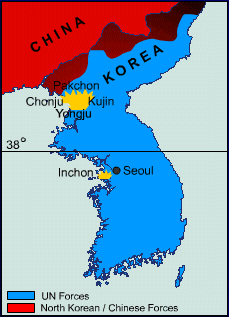
At a meeting held on Wake Island on the 15th of October, Truman agreed to MacArthur's request, on the condition that he did not provoke a Chinese entry into the war. MacArthur, like the US State Department, believed that China would not intervene in Korea because it did not want to lose the opportunity to regain its permanent seat on the Security Council and was ill-prepared for war with the US (and would have to rely on the USSR for military aid). UN forces pushed north of the 38th Parallel and by the middle of October were extremely close to the River Yalu, where the DPRK bordered the PRC. At this point, Mao and his leading advisers ordered 300,000 Chinese troops to enter North Korea. The entry of the PRC into the war appears to be a combination of fears concerning any US presence near the PRC-DPRK border as well as Soviet pressure inducements. Moreover, the CCP feared the potential presence of US aircraft flying over rebuilding efforts in Manchuria, where the great majority of the latter part of the Chinese Civil War was fought. The first Chinese engagements with UN forces were carefully calculated to lull MacArthur into a false sense of security. The US won these battles easily and, overconfidently, continued to push further into North Korea, overextending their supply lines in the process. The Chinese then launched a pincer attack and surrounded and cut off UN forces in the DPRK. Eventually, the Chinese incursion pushed the UN forces back south of the 38th Parallel and communist forces seized Seoul once more. The UN forces were humiliated, demoralized and in retreat. |

|
The recall of MacArthur and appointment of Ridgeway
|
Since August 1950, the US had been unable to work through the UN Security Council as the Soviet delegate had return to his seat and vetoed any attempts to pass resolutions. This would be crucial when the US attempted to end the war on favourable terms. Following Chinese intervention in the war and subsequent UN retreat, US forces lost confidence in MacArthur, as explained by Captain Charles Bussey:
"We'd been humiliated, debased, overwhelmed- routed -Intelligence said they hit us with one-third of a million men. They turned our army into a leaderless horde, running headlong for Pusan. Our soldiers had lost every bit of confidence in all of their leaders, from the commander-in-chief to platoon leaders." Moreover, when Truman ill-advisedly refused to rule out the use of a nuclear bomb in a White House press conference at the end of November 1950, UK Prime Minister Clement Atlee urgently flew to Washington to express his concern. Here is the transcript of Truman's gaffe: Q. Mr. President, I wonder if we could retrace that reference to the atom bomb? Did we understand you clearly that the use of the atomic bomb is under active consideration? Truman: Always has been. It is one of our weapons. Q. Does that mean, Mr. President, use against military objectives, or civilian-- Truman: It's a matter that the military people will have to decide. I'm not a military authority that passes on those things. Q. Mr. President, perhaps it would be better if we are allowed to quote your remarks on that directly? Truman: I don't think—I don't think that is necessary. Q. Mr. President, you said this depends on United Nations action. Does that mean that we wouldn't use the atomic bomb except on a United Nations authorization? Truman: No, it doesn't mean that at all. The action against Communist China depends on the action of the United Nations. The military commander in the field will have charge of the use of the weapons, as he always has Truman was anxious not to lose the support of his NATO allies in Western Europe should the Korean War be expanded. Tensions between Truman and MacArthur had begun to emerge even before the Chinese intervention as Truman was frustrated with some of MacArthur's public statements that appeared to question the policy of the administration. |
|
|
|
Increasingly, it became clear that MacArthur and Truman viewed events in Korea differently and that they would not be able to work to overcome these differences. MacArthur wanted to continue 'rollback' and expand the war to include mainland China. MacArthur even wanted to use nuclear weapons on the Chinese (believing that the decision to use them was his and not Truman's, a not unreasonable interpretation based on Truman's press conference) and introduce radioactive liquids into the River Yalu. Furthermore, MacArthur passionately believed that the "Europe-first" policies of the Truman administration were wrong and that the Cold War would be won and lost in Asia. He even released a statement on the floor of the House of Representatives to criticize these policies:
"It seems strangely difficult for some to realize that here in Asia is where the Communist conspirators have elected to make their play for global conquest, and that we have joined the issue thus raised on the battlefield; that here we fight Europe’s war with arms while the diplomatic there still fight it with words; that if we lose the war to communism in Asia the fall of Europe is inevitable; win it and Europe most probably would avoid war and yet preserve freedom. As you pointed out, we must win. There is no substitute for victory." Although this public insubordination was the final straw for Truman, his decision to relieve MacArthur of command of US forces was made easier as there was a ready made replacement in Matthew Ridgway, who had successfully begun a fightback against the combined North Korean and Chinese forces by adopting the doctrine of attrition, essentially ensuring that the war in Korea would be fought more on US terms. Ridgway's successes did much to improve morale among the armed forces. When Ridgway took over on the 11th April 1951, he continued his spring and summer offensives that recaptured Seoul and stabilized the fighting around the 38th Parallel. |
Negotiations to end the war
The recall of MacArthur, although widely unpopular with the American public and resulting in some constitutional implications, reaffirmed the principle of civilian control of the military. In the short-term, it also ensured that the Korean War remained limited and prevented a potential split among the NATO powers. The US strategy in Korea focussed on negotiating an end to what was rapidly becoming an unpopular war with no end in sight.
Negotiations with the Soviets and Chinese were secret at first because Rhee was determined to blocking any ceasefire and there was a massive concern that he would order ROK forces to continue fighting, regardless of the orders given to UN troops. By the end of July 1951, Ridgway had begun negotiating an end to the war that covered a number of issues which included:
The UN successfully managed to prevent a discussion of withdrawal of foreign troops from the Korean peninsula, realizing the the DPRK forces were superior to the ROK. Both the PRC and USSR were open to negotiation as a result of the changing nature of the war. Ridgway's change of strategy had convince Mao that the UN forces could not be decisively defeated and that China would continue to sustain heavy losses if it continued to engage them while UN embargoes launched against the PRC meant that supplies were low. Stalin continued to wish to avoid all-out war with the US over Korea and also realized that the Chinese intervention had achieved all it could hope to by this point. Despite there now existing a desire on all sides to end the war, it continued for another two years as both sides tried to wrestle more the best possible terms to an armistice.
Originally the negotiations were held around Kaesong (located within no-mans land) but after the Chinese seized this area and were able to control movement into and out of the negotiating area, it was used as a way to gain a psychological edge over the UN forces and the US in particular. Inevitably,these negotiations broke down over this point (as well as over arguments regarding the location of the line of ceasefire) and both sides engaged in a destructive air war. This culminated in a napalm raid on military and industrial targets in Pyongyang in late June 1952 which cost the lives of at least 6000 civilians. International outrage forced the US to take greater care in preventing civilian casualties.
By October 1951, negotiations move to Panmunjon and both sides took responsibility for securing the negotiating area. Negotiations continued to be hampered by mutual distrust (both sides took advantage of breaks in the fighting to rearm and secure their positions) and the issue of prisoner exchanges. While Mao wanted an all-for-all exchange, the US feared that this would leave the Communists with a significant numerical advantage. Moreover, many of the 132,000 communist POWs held in UN POW camps did not want to be repatriated. Many of the North Korean prisoners were actually from the South who had been conscripted into the DPRK forces but 16,000 out of the 21,000 Chinese prisoners said they did not want to return to the PRC. This issue continued to prevent the signing of an armistice until July 1953.
Negotiations with the Soviets and Chinese were secret at first because Rhee was determined to blocking any ceasefire and there was a massive concern that he would order ROK forces to continue fighting, regardless of the orders given to UN troops. By the end of July 1951, Ridgway had begun negotiating an end to the war that covered a number of issues which included:
- Ceasefire and armistice arrangements
- The composition and authority of a supervisory body for carrying out the terms of any agreement
- A ceasefire line along the 38th Parallel
- Transferral of prisoners
The UN successfully managed to prevent a discussion of withdrawal of foreign troops from the Korean peninsula, realizing the the DPRK forces were superior to the ROK. Both the PRC and USSR were open to negotiation as a result of the changing nature of the war. Ridgway's change of strategy had convince Mao that the UN forces could not be decisively defeated and that China would continue to sustain heavy losses if it continued to engage them while UN embargoes launched against the PRC meant that supplies were low. Stalin continued to wish to avoid all-out war with the US over Korea and also realized that the Chinese intervention had achieved all it could hope to by this point. Despite there now existing a desire on all sides to end the war, it continued for another two years as both sides tried to wrestle more the best possible terms to an armistice.
Originally the negotiations were held around Kaesong (located within no-mans land) but after the Chinese seized this area and were able to control movement into and out of the negotiating area, it was used as a way to gain a psychological edge over the UN forces and the US in particular. Inevitably,these negotiations broke down over this point (as well as over arguments regarding the location of the line of ceasefire) and both sides engaged in a destructive air war. This culminated in a napalm raid on military and industrial targets in Pyongyang in late June 1952 which cost the lives of at least 6000 civilians. International outrage forced the US to take greater care in preventing civilian casualties.
By October 1951, negotiations move to Panmunjon and both sides took responsibility for securing the negotiating area. Negotiations continued to be hampered by mutual distrust (both sides took advantage of breaks in the fighting to rearm and secure their positions) and the issue of prisoner exchanges. While Mao wanted an all-for-all exchange, the US feared that this would leave the Communists with a significant numerical advantage. Moreover, many of the 132,000 communist POWs held in UN POW camps did not want to be repatriated. Many of the North Korean prisoners were actually from the South who had been conscripted into the DPRK forces but 16,000 out of the 21,000 Chinese prisoners said they did not want to return to the PRC. This issue continued to prevent the signing of an armistice until July 1953.
Armistice
The election of Dwight Eisenhower as president of the USA in November 1952 and the death of Stalin in March 1953 played a significant role in ending the war. Eisenhower had pledged to bring about an end to a desperately unpopular war that was a major factor in Truman's decision not to seek re-election and the loss of the presidency by the Democrats. His administration wanted to convey the impression to both the PRC and the USSR that the USA were prepared to expand the war and use any weapon at his disposal to bring about a ceasefire. Therefore, Eisenhower confirmed that he had ordered the US Navy to not intervene in the event of any GMD attacks on the PRC from Taiwan (this had been the role of the US 7th fleet stationed in the Taiwan Straits) and sanctioned a letter from chief UN negotiator, US General Mark Clark, issuing an ultimatum that any Chinese and North Korean failure to agree to US proposals over prisoner exchanges would not viewed positively. In the USSR, the triumvirate of leaders (Khrushchev, Malenkov and Beria) who succeeded Stalin made overtures to the US about desires for peaceful co-existence.
Moreover, the PRC government began to focus on domestic matters as Mao wished to begin China's 1st Five Year Plan in 1953 and needed to redirect spending away from the military budget. The US bombing raids of North Korea had severely dented public morale and in the face of a dramatic decrease in average individual income and rampant inflation, people engaged in storing food and forcing Kim's government to respond by introducing harsh confiscatory policies. By the summer of 1953, it was clear that the DPRK could not longer continue to wage war.
Moreover, the PRC government began to focus on domestic matters as Mao wished to begin China's 1st Five Year Plan in 1953 and needed to redirect spending away from the military budget. The US bombing raids of North Korea had severely dented public morale and in the face of a dramatic decrease in average individual income and rampant inflation, people engaged in storing food and forcing Kim's government to respond by introducing harsh confiscatory policies. By the summer of 1953, it was clear that the DPRK could not longer continue to wage war.
Legacy of the Korean War
The relationship between the two superpowers
In many ways, the Korean War set the tone for Cold War conflicts, especially in Asia. Despite flirting with 'rollback' when allowing MacArthur to cross the 38th Parallel in 1950 (an example of ill-fated Ad Hoc policy making), Truman's policy of containment was confirmed as the official US Cold War doctrine. Despite arguably being a flawed doctrine (it committed the US to essentially fighting defensive wars regardless of the strategic or economic importance of the 'interests' they were protecting), it nevertheless ensure limited wars without the use of nuclear weapons. Equally, the USSR had shown that it also was not prepared to engage the US directly in a land war. This is especially significant on the heels of the Berlin Blockade- both sides had now avoided confrontation in Europe and Asia. However, like the Berlin Blockade, it did reaffirm the strategy that both sides attempted at various points during the first half of the Cold War- how to get as close as possible to threatening war without actually engaging the enemy. This approach would ultimately manifest itself in the nuclear policy of Brinkmanship.
In many ways, the Korean War set the tone for Cold War conflicts, especially in Asia. Despite flirting with 'rollback' when allowing MacArthur to cross the 38th Parallel in 1950 (an example of ill-fated Ad Hoc policy making), Truman's policy of containment was confirmed as the official US Cold War doctrine. Despite arguably being a flawed doctrine (it committed the US to essentially fighting defensive wars regardless of the strategic or economic importance of the 'interests' they were protecting), it nevertheless ensure limited wars without the use of nuclear weapons. Equally, the USSR had shown that it also was not prepared to engage the US directly in a land war. This is especially significant on the heels of the Berlin Blockade- both sides had now avoided confrontation in Europe and Asia. However, like the Berlin Blockade, it did reaffirm the strategy that both sides attempted at various points during the first half of the Cold War- how to get as close as possible to threatening war without actually engaging the enemy. This approach would ultimately manifest itself in the nuclear policy of Brinkmanship.
|
For Eisenhower, the negotiated end to the Korean War was a personal triumph (as evidenced by the 1956 election campaign TV commercial to the right) and allowed for a change in direction in Cold War policy. Eisenhower embarked on a 'new look' that reduced overall military spending and drastically decreased the role of manpower. His administration focussed on building up a stockpile of nuclear weapons instead and engaged in a series of CIA covert operations in countries such as Iran and Guatemala.
By 1955, Nikita Khrushchev had emerged as the undisputed leader of the Soviet Union and while relations between the two superpowers remained tense for the rest of the 1950's and early '1960's, he too observed many of the unofficial boundaries jotted out by Truman and Stalin during the early Cold War period. |
|
North and South Korea
Korea remained divided at the 38th Parallel and while Korean nationalism had been a driving force in causing this conflict, ironically both the DPRK and ROK were reliant on (and largely at the mercy of) the two superpowers. Despite both Kim and Rhee attempting to use Korean nationalism to unite the Korean peninsula and impose their vision of government upon the other, they could not ultimately extricate themselves from a position where both needed the support of their sponsoring superpower. Both sides had suffered tremendous damage and loss of life during the war and spent much of the 1950's rebuilding. The DPRK's economy began growing at a faster rate earlier than the ROK- by 1957, industrial production was back to pre-1949 levels. Kim Il-Sung, a Stalinist, opposed and denounced Khrushchev's policy of De-Stalinization and aligned itself with China in condemning the 'revisionism' of Khrushchev's USSR. However, unlike China, it maintained ties with the USSR. Following Chinese normalization of relations with the West in the 1970's (along with the death of Mao), the PRC began re-evaluating its relations with the DPRK and Kim began to sever ties in response. This would prove to be tremendously costly as by the late 1980's North Korea entered a period of economic decline from which it has yet to emerge. This decline was exacerbated by the collapse of the USSR in 1991 and wide spread flooding in the mid-1990s. Kim's successor, his son Kim Jong-il, re-established ties with China but was also forced to accepted UN food aid.
In contrast, the South took longer to emerge from post-war economic difficulties. Rhee was beset by corruption scandals which culminated in student protests and a constitutional crisis in 1960. Rhee was removed from power in a coup d'etat led by General Park Chung-Hee and, bolstered by substantial US aid, 1962 saw the beginning of a period of unprecedented economic growth ('The Miracle on the Han River') fuelled by exports. Despite leading this economic growth, Park also continued the political repression of his predecessor and ruled until his assassination in 1979. His death, along with the despotic excesses of his successor (Chun doo-Hwan), ultimately led to installation of democracy in South Korea by the late 1980's. Since 2000, South Korea has tried to engage diplomatically with North Korea as part of its 'Sunshine Policy'.
China
The Korean War was a huge boost to the fledgling PRC. Mao's government had shown that they could successfully defend their revolution from would-be external enemies and held their own against technologically superior US forces. However, the war was very significant with regard to causing the Sino-Soviet split. Although Mao had huge respect for Stalin, he was resentful of the way in which he was excluded from discussions between Mao and Kim in 1949 and 1950. He was insulted to be informed second-hand by Kim that the PRC was expected to intervene in the event of a deteriorating situation for DPRK forces and was anxious not to be treated as a client-state of the USSR. In fact this last point, was picked up George Kennan (The US State Department's 'Mr. X' and author of the Long Telegram) who argued that China had aligned itself with the Soviet Union only for short-term geopolitical purposes. Following the death of Stalin, the rise to power of Khrushchev and his subsequent 'secret speech' (where he denounced Stalin), China continued to move further away from the USSR. Following the disaster of the 'Great Leap Forward' by 1960, a Sino-Soviet Split had clearly emerged.
The road to Vietnam
Finally, from a Cold War perspective, the most significant legacy of the Korean War was to set the USA on a path to war in Vietnam. The end of the war in Korea appeared to stabilize the geopolitical situation in the Far East and be held up as a successful example of containment. In 1954, the superpowers began to focus on Southeast Asia when the Vietminh defeated the French at Dien Bien Phu. At the subsequent peace conference in Geneva, the Eisenhower administration first began to publicly and openly talk about domino theory in regard to Vietnam. The idea of falling dominoes in Asia had been discussed behind closed doors prior to this and it was clear that the US experience in Korea played a significant role in the formulation of this theory. The spectre of Chinese involvement in Korea was also a significant factor in US military strategy during the war in Vietnam; namely their fear of advancing north of the 17th Parallel.
Korea remained divided at the 38th Parallel and while Korean nationalism had been a driving force in causing this conflict, ironically both the DPRK and ROK were reliant on (and largely at the mercy of) the two superpowers. Despite both Kim and Rhee attempting to use Korean nationalism to unite the Korean peninsula and impose their vision of government upon the other, they could not ultimately extricate themselves from a position where both needed the support of their sponsoring superpower. Both sides had suffered tremendous damage and loss of life during the war and spent much of the 1950's rebuilding. The DPRK's economy began growing at a faster rate earlier than the ROK- by 1957, industrial production was back to pre-1949 levels. Kim Il-Sung, a Stalinist, opposed and denounced Khrushchev's policy of De-Stalinization and aligned itself with China in condemning the 'revisionism' of Khrushchev's USSR. However, unlike China, it maintained ties with the USSR. Following Chinese normalization of relations with the West in the 1970's (along with the death of Mao), the PRC began re-evaluating its relations with the DPRK and Kim began to sever ties in response. This would prove to be tremendously costly as by the late 1980's North Korea entered a period of economic decline from which it has yet to emerge. This decline was exacerbated by the collapse of the USSR in 1991 and wide spread flooding in the mid-1990s. Kim's successor, his son Kim Jong-il, re-established ties with China but was also forced to accepted UN food aid.
In contrast, the South took longer to emerge from post-war economic difficulties. Rhee was beset by corruption scandals which culminated in student protests and a constitutional crisis in 1960. Rhee was removed from power in a coup d'etat led by General Park Chung-Hee and, bolstered by substantial US aid, 1962 saw the beginning of a period of unprecedented economic growth ('The Miracle on the Han River') fuelled by exports. Despite leading this economic growth, Park also continued the political repression of his predecessor and ruled until his assassination in 1979. His death, along with the despotic excesses of his successor (Chun doo-Hwan), ultimately led to installation of democracy in South Korea by the late 1980's. Since 2000, South Korea has tried to engage diplomatically with North Korea as part of its 'Sunshine Policy'.
China
The Korean War was a huge boost to the fledgling PRC. Mao's government had shown that they could successfully defend their revolution from would-be external enemies and held their own against technologically superior US forces. However, the war was very significant with regard to causing the Sino-Soviet split. Although Mao had huge respect for Stalin, he was resentful of the way in which he was excluded from discussions between Mao and Kim in 1949 and 1950. He was insulted to be informed second-hand by Kim that the PRC was expected to intervene in the event of a deteriorating situation for DPRK forces and was anxious not to be treated as a client-state of the USSR. In fact this last point, was picked up George Kennan (The US State Department's 'Mr. X' and author of the Long Telegram) who argued that China had aligned itself with the Soviet Union only for short-term geopolitical purposes. Following the death of Stalin, the rise to power of Khrushchev and his subsequent 'secret speech' (where he denounced Stalin), China continued to move further away from the USSR. Following the disaster of the 'Great Leap Forward' by 1960, a Sino-Soviet Split had clearly emerged.
The road to Vietnam
Finally, from a Cold War perspective, the most significant legacy of the Korean War was to set the USA on a path to war in Vietnam. The end of the war in Korea appeared to stabilize the geopolitical situation in the Far East and be held up as a successful example of containment. In 1954, the superpowers began to focus on Southeast Asia when the Vietminh defeated the French at Dien Bien Phu. At the subsequent peace conference in Geneva, the Eisenhower administration first began to publicly and openly talk about domino theory in regard to Vietnam. The idea of falling dominoes in Asia had been discussed behind closed doors prior to this and it was clear that the US experience in Korea played a significant role in the formulation of this theory. The spectre of Chinese involvement in Korea was also a significant factor in US military strategy during the war in Vietnam; namely their fear of advancing north of the 17th Parallel.